
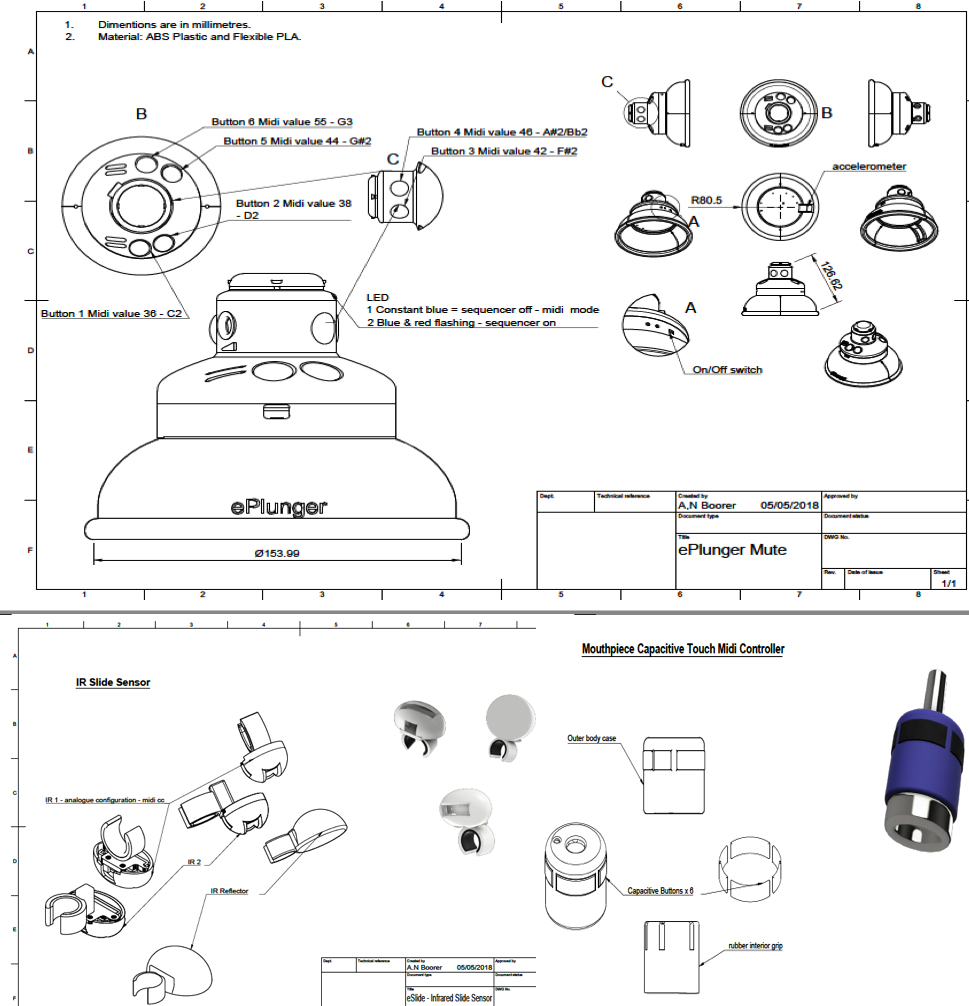
The eBone system is a bespoke augmentation system designed for the integration, or blending, of live electronics and the trombone. It consists of an electronic plunger mute (ePlunger), an infrared slide sensor (eSlide) and a mouthpiece shield midi control switch.
There has been a burgeoning interest in the amalgamation of traditional instruments and electronics since Jean-Baptiste Thillaie invented the clavecin électrique in 1759, but it’s the relatively recent accessibility of microcontrollers like the Arduino and microprocessors like the Raspberry Pi that have paved the way for experts and hobbyists alike to experiment and invent hybrid instruments in their spare room. I’ll be examining and comparing these innovations throughout this blog, but it’s crucial for me to differentiate between hybrid instruments and what I see as electroacoustic augmentation. Hybrid instruments are bespoke with electronics fastened or built into the traditional design of the instrument usually without recourse to remove them during a performance. They are typically conventional musical instruments that have been adapted to integrate with electronics. This is not uncommon within the practices of electroacoustic music and musical instruments per se, but it is not so prevalent in the brass community. Within this community, trumpet players seem to have taken the lead from subtle permutations to completely reimagined designs, as with Ben Neill’s mutantrumpet.
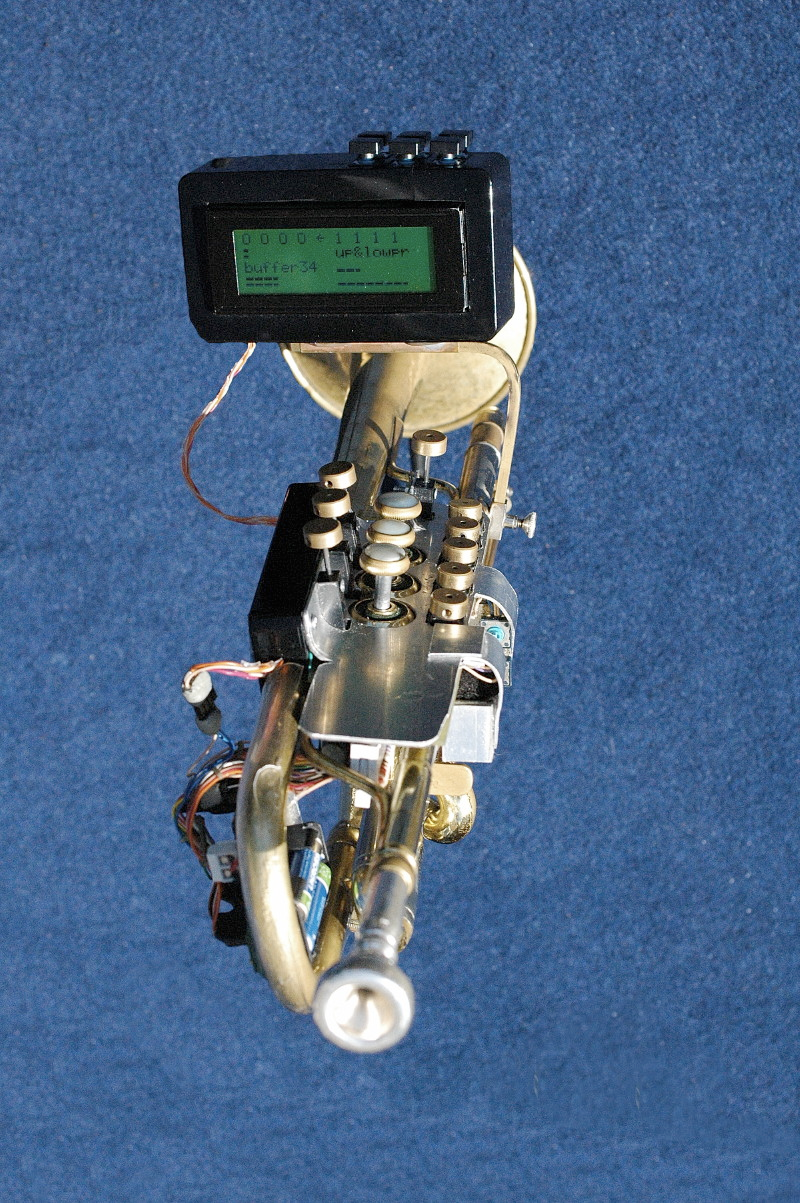
Another more subtle example of a hybrid trumpet that sails close to the wind of augmentation is the electrumpet by Hans Leeuw. The electrumpet follows in a tradition developed by Sukander Kartadinata and Johnathan Impett, an approach that attempts to maintain the natural playing position of the performer without interfering with the finely tuned gestural actions learned over time and required to proficiently play. Impett and Kartadinatta developed a meta-trumpet that adds controller extensions such as pressure sensors, potentiometers and force sensitive resistors, rather than a reimagined overhaul of the trumpet. Whether extended controllers or reimagined instruments, all hybrid instruments or augmentation devices have similar goals; that of incorporating interactive electronics and enhancing the acoustic properties of a conventional musical instrument.
Surprisingly, very little has been done concerning the augmentation or reimagining of the trombone. We trombonists are like the evolutionary equivalent of Bronze Age Britain; while Egypt is constructing enormous obelisks, we are still content with wattle and daub homes. This might sound harsh, and there are talented young trombonists out there who have tapped into the entrepreneurial potential of sites like youtube to promote their impressive arrangements of electronic looping or programming, but there is very little out there in the area of hardware augmentation for interactive electronics. The stage was set for hybrid instrumental development on the trombone as far back as 1986 when Dr Nicolas Collins revealed his ‘trombone propelled electronics’. Collins’ work used a homemade DSP (Digital Signal Processing) system to control different samples played through the trombone. Collins is not a trombonist, but he adapted the instrument as a DSP control devise. This demonstrated the potential for augmentation, but the baton seems to have been missed by trombonists and taken on by other instrumentalists.
The eBone system follows more in the tradition of Impett and Leeuw, except for an independent handheld electronic plunger mute that incorporates most of the technology and sensors. This is pure augmentation in that it follows a traditional playing technique (holding the mute while playing) and processes the sound of the instrument without changing or adding to the instrument design in any way. The slide sensor is more Leeuw’s conceptualisation of augmentation, although the sensors are designed so they can clip on and off easily. The midi controller extension is a shield that fits over a traditional mouthpiece and can be easily removed during a performance. Leeuw’s design also uses removable parts, but I’m not sure of the possibility of removal during a performance. So, the eBone system follows a unique abstraction of augmentation that borrows from the above design concepts while the mute and mouthpiece controller maintains some autonomy from the instrument. In fact, the ePlunger mute could be used as a controller, midi sequencer and microphone independently of the trombone.
 The eBone Project